
Catching The Rabbit Slowly
An update to an ongoing quest

“Sometimes you have to catch the rabbit slowly” is an expression I once heard to describe situations in which patience, strategy, and a long-term view lead to the best solution for complex or overwhelming problems. Though I don’t quite recall where I heard it, I’ve long cherished this idiom, perhaps because it resonates so strongly with my own approach to life as a dyspraxic individual with a slow cognitive processing speed. I may not be particularly fast, efficient, or dynamic, but I am persistent and strategic over time.
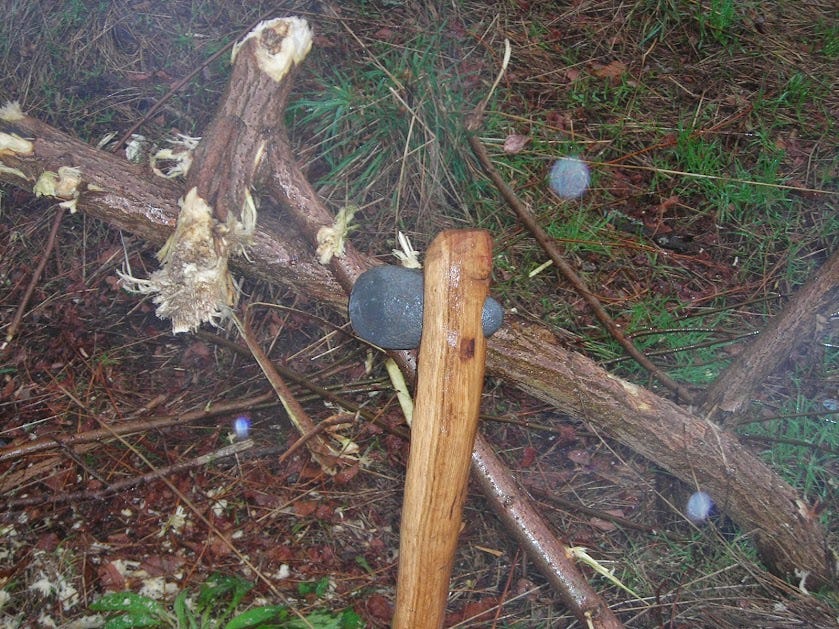
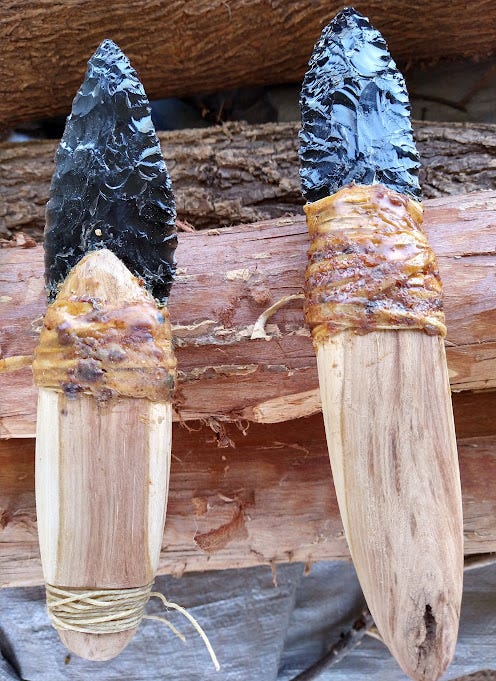
Pairing persistence with a long-term yet flexible strategy is the approach I’ve chosen to address a challenge I previously wrote about: my efforts to revive my long-dormant special interest in ancient stone tool-making (also known as “flintknapping”) and other ancient skills, such as friction fire-making, natural cordage weaving, etc. Primitive technologies and human prehistory are subject areas I have long been passionate about, having first become acquainted with them during late adolescence, at around the same time I also first realized that I am likely neurodivergent in some way. I wrote about this pivotal moment in my life in my published memoir, Disrupted Pathways: A Dyspraxic Odyssey. For me, it wasn’t just a hobby; it became a grounding force in my life, ultimately leading me to earn both a BA in anthropology and an MA in Experimental Archaeology. While I don’t presently work in those fields, I maintain an interest in the subject matter.
Over time, however, numerous factors gradually pulled me away from my special interest. Among them were traumatic experiences that became associated with it, resulting from the bullying and exclusion I dealt with in graduate school. I wrote about these experiences in a much earlier post titled Poisoned by Ableism. However, the more long-standing and still highly relevant barrier for me in reconnecting with my special interests has been dire time famine, resulting from an intractably slower working speed combined with the necessary burden of devoting countless hours to a rigorous, time-consuming health regimen. Both the slow working speed and special health needs that necessitate such monastic devotion to cumbersome health regimens are related to my dyspraxia, and leave me with little time and energy for anything else. Hence, any non-writing-related special interests fall by the wayside all too easily. I wrote about this in my post Quasi-Athletic Lifestyle by Reason of Dire Medical Necessity.
Other neurodivergent authors here on Substack have written about losing touch with special interests and the gigantic hole in the heart this creates for neurodivergent people. This is a pain that has tormented my soul for years now.
This past summer, I attempted with every fiber of my being to get in more flintknapping time. Still, ultimately, I was barely able to even skim the surface of the amount of knapping I intended to do. The combination of working on producing more written work for publication, my ever-so-vital health regimen, and the additional burden of never-ending lawn maintenance very much ate up most of my time.
The truth is, as a dyspraxic person, I don’t have the same twenty-four hours a day as everyone else. Thus, it is difficult for me to juggle too many different things in my life. It seems this can be said for other neurodivergences, too.
Moreover, it almost seems like, as a dyspraxic, it is difficult to “mentally shift gears and retool” for activities that differ too drastically from those that are more customary to your day-to-day life—In my case, writing and working out assiduously. I get locked into a specific range of activities and cannot easily shift my focus to anything else, no matter how much I might wish to.
My Current Resolution:
I’m not ready to give up just yet. Those times I was able to get out and knap, I was every bit as engaged in the process as usual. My passion, enthusiasm, and inquisitiveness haven’t wavered one iota. My mind would formulate hypotheses about technological practices in human prehistory and ways to test them through experimentation. I was captivated by the same wonder and intellectual curiosity that first drew me to this activity as a high school junior. This is the kind of engagement my mind needs—something completely esoteric, with no seemingly practical purpose other than personal enrichment and the satisfaction of doing something to the best of my abilities, just for its own sake.
Obviously, my literary activism on matters pertaining to neurodiversity is very satisfying and rewarding in its own way. Still, much like my health regimen, it feels more like an endeavor I had to take up out of necessity—a necessity incurred vis-à-vis the various forms of systemic ableism I have dealt with my entire life.
So while a part of me is mentally preparing for the eventuality that it might, at some point, simply be best to let go of my special interest in primitive technologies peacefully, I’m going to make another go at it next year before calling it quits.
While I have folded up all my flintknapping tools and equipment for the year, I am already planning my flintknapping and primitive technology projects for next summer. I hope, by that point, my second book project will be in the professional editing phase, and I will plan my other writing projects to better enable me to build in time for flintknapping. Perhaps longer-term planning and setting goals will be key here. I’ll see if it works.
If I can complete at least half of the knapped stone implements I plan to make next year, I will have another go at it the following year. If not, and I just cannot get any traction on these projects, perhaps that will be the point where I may just peacefully let it go. At some point, it just no longer makes sense to expend too much time and energy fighting the tide of the inevitable.
Conclusion:
What I just related is an account of dyspraxic inquisitiveness and creativity coming up against the temporal reality of intractable inefficiencies and the strained time budget these incur.
Special interests are often a critical cornerstone and anchor in neurodivergent life, but sadly, life can pull us away from these pursuits, leaving us greatly diminished. If anything I’ve said here resonates in any way, please feel free to comment down below. Thanks for reading!
I feel you 100% here. I still manage to read a lot. That's kind of nonnegotiable for me, since I'm pretty sure I'd fall apart completely if I didn't. But writing has been hard to find time for lately, and other interests, sourdough baking and brewing for example, have falling by the wayside largely or completely.
It's all exacerbated by my desire to read and comment on so much here, about which I feel vaguely lame or guilty if I don't do. (And which I decided to spend some time on this morning instead of writing. Ha.)
Creating time for special interests is definitely a challenge. I really enjoy visiting local parks and watching the animals. Also, I love to read but don't really have as much time as I want to read. On the weekends I am trying to strictly guard time for these activities. One of my post 50 realizations is how important it is to "play". Life has got to be more than work and your "To do" list!!